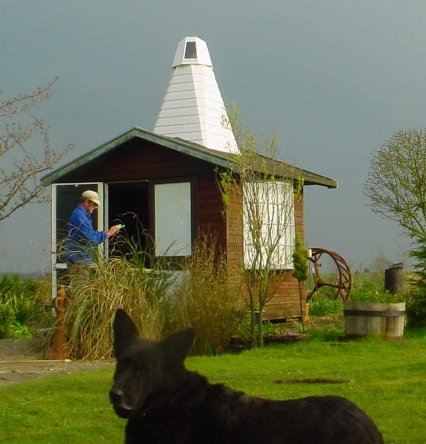

Willett's Camera Obscura Builds.
'Amazing Camera Obscura' was born of an enthusiastic interest in Camera Obscura.
Since we built our first camera obscura for the Cornwall eclipse in 1999, we have gained experience that we can make available to all.
We are able to build a Camera Obscura from scratch. Alternatively it is possible to install optics into an existing building, be it a garden summer-house or a suitable room. We are also happy to work in conjunction with designers and architects on new projects.
Site visits can be arranged via our contacts page.
Making Your Own Camera Obscura
Simple camera obscura can be made in the following ways.
Open cardboard boxes out flat, and then use them to black out the windows in a room by pinning or taping them around the window frame. The room must be completely dark as any light coming in will ruin the image, use some tape to cover any small chinks of light. Next make a hole in one of the cardboard blackouts using a pencil, this will then project an image on to the opposite wall - hang up a white sheet if the wall is a dark colour. The image will be very dim, and it may take a few minutes before your eyes will adjust to the low light levels and the image becomes visible. A larger hole will let more light through, but will make for a more blurry image - experiment with the hole size until you reach a compromise between sharpness and brightness.
A large hole will make the image more blurry - that is unless you put a lens in the hole. A lens can be purchased from our Shop page look for a meniscus lens.
For our purposes the focal length is the distance between the hole and the wall. If the wall is 2m away then the
focal length will be 2m.
Cut a hole of a suitable size for the lens and fix it in place with tape. This will give you a brighter image.
You Will Need:
Templates - printed onto light card (approx 220gsm) Download Template
Forming Tube - around 70mm diameter tube/Disposable plastic water bottle
Plastic Lens which you can find on our Shop page
Tracing Paper
Sticky Tape
Scissors
Stapler
Instructions
- 1. Roll Screen card around Forming Tube and tape up.
- 2. Trace the outer part of top Lens Disc onto the tracing paper and cut out.
- 3. Fix Tracing paper screen over one end of screen tube with tape.
- 4. Roll lens tube around screen tube and tape.
- 5. Cut out Lens Discs.
- 6. Sandwich lens between discs and staple together.
- 7. Fix assembled Lens Holder over the end of the lens tube.
- 8. Look at screen through tube, slide the Screen Tube in and out of Lens Tube to focus the image.

Lenses can be used but due to fixed focal length, camera size needs to relate directly to the focal length of the lens being used. Here is an opportunity for experimentation.